The Ibiza Behind the Brochure
Local culture, quieter villages and the practical context that makes an Ibiza trip feel more considered than a hotel search result.
Elena Marí · 16 min read · Checked August 2026
The short answer
- Founded
- 654 BC, by Phoenicians from Cádiz
- UNESCO listed
- 1999 — Ibiza, Biodiversity and Culture
- Resident population
- About 160,000
- Annual visitors
- Around 3.4 million
- Languages
- Catalan (Eivissenc) and Spanish
- Best season to understand it
- Winter
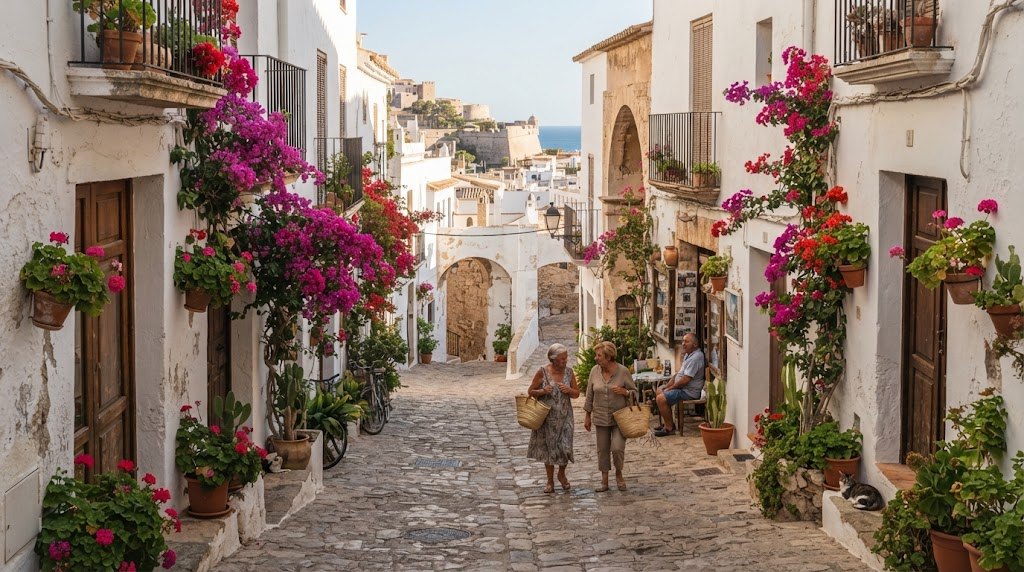
Ibiza has been continuously inhabited for about 2,700 years and internationally famous for about sixty. That ratio explains most of what is confusing about the place. Underneath the season is a small Catalan-speaking Mediterranean island with a salt industry, a fortified capital, a village fiesta calendar and a rural architecture of thick whitewashed walls that Le Corbusier admired long before anyone opened a club here.
Twenty-seven centuries, briefly
The Phoenicians founded a settlement at Sa Caleta in 654 BC and moved to the natural harbour of what is now Ibiza Town shortly after. Under Carthage the island grew rich on salt, lead and a dye industry, and buried its dead in the hillside necropolis at Puig des Molins — over 3,000 tombs, the largest Punic burial ground in the western Mediterranean.
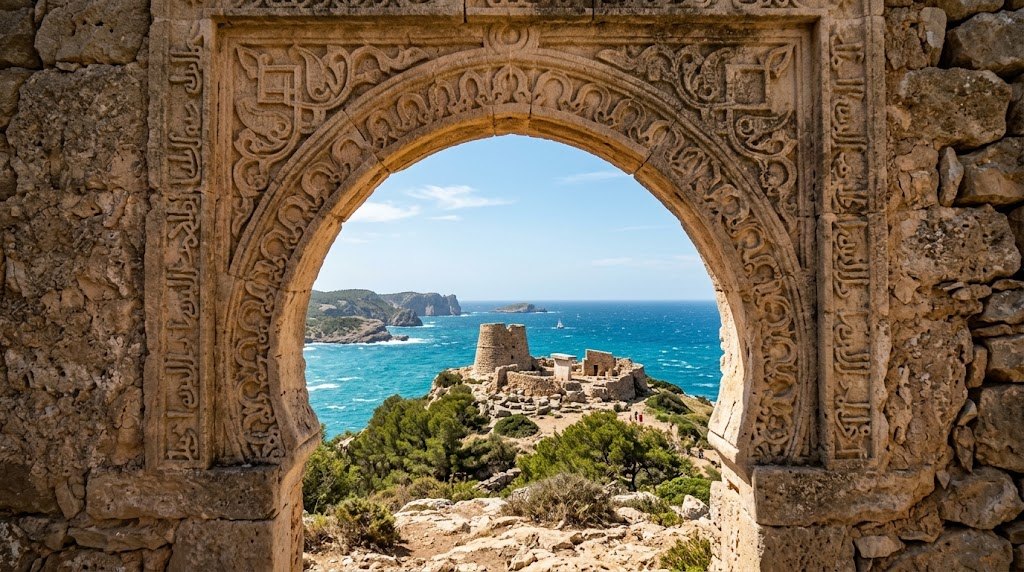
Rome took it in 123 BC. The Vandals, Byzantines and then the Moors followed; the Islamic period, from 902 to 1235, left the island's irrigation systems, the terracing you can still see in the interior, and a good deal of the vocabulary. The Catalan conquest in 1235 brought the island into the Crown of Aragon and set its language.
The Renaissance walls went up between 1554 and 1585, when Ottoman and Barbary raiding made the old medieval defences useless. They are the reason there is a UNESCO site here. For the next three centuries Ibiza was poor, remote and largely ignored — an island of salt workers, fishermen and almond farmers, whose young men emigrated.
Then, from the mid-1960s, the hippies. Then, from the late 1980s, the clubs. The airport handled about 8.2 million passengers in 2024. Both things happened inside one lifetime, which is why you can still meet people who remember the island before either.
What UNESCO actually listed
The 1999 inscription is a mixed cultural and natural listing — rare, and worth understanding because it explains what is protected and what is not. Four components:
- The Posidonia meadows in the channel between Ibiza and Formentera — a seagrass ecosystem including some of the oldest living organisms on earth, and the direct reason the water is that colour.
- Sa Caleta, the original 654 BC Phoenician settlement on the south coast.
- Puig des Molins, the Punic and Roman necropolis in Ibiza Town.
- Dalt Vila, the upper town and its complete 16th-century bastioned walls.
That turquoise is not a filter and not the sand. It is 100,000-year-old seagrass filtering the channel between here and Formentera — and it is the part of the island most easily destroyed by anchors.
Language and identity
Both Catalan and Spanish are official. The island's Catalan, Eivissenc, is the language of the villages, the road signs and the schools; Spanish is the language of the tourist economy and of most of the mainland-born population. Learning six words of Catalan — bon dia, gràcies, si us plau, adéu — lands very differently from the Spanish equivalents in a village bar, and costs you nothing.
The hippy legacy
The counter-culture arrived because Ibiza in 1965 was cheap, warm, hard to reach and politically overlooked. What it left behind is more than a market stall aesthetic: the two hippy markets, the Sunday drumming at Benirràs, a genuinely tolerant social register, the island's unusually strong vegetarian cooking, and a wellness economy that predates the word wellness by four decades. It also left an aesthetic that the luxury market has spent twenty years monetising, which is its own kind of joke.
The island under pressure
Roughly 3.4 million visitors a year arrive on an island of 160,000 residents, and the strains are specific rather than vague. Water is the sharpest: Ibiza's aquifers are over-extracted and saline intrusion is measurable, so the island now depends heavily on desalination. Housing is the most socially damaging — long-term rentals have largely been converted to summer lets, and seasonal workers sleep in vans and shared rooms. The seagrass is damaged by anchoring. And the road network, built for a fraction of the traffic, simply stops working in August.
- Area
- 572 km² — about 41 km long
- Resident population
- ≈160,000, roughly a third in Ibiza Town
- Annual visitors
- ≈3.4 million
- Airport passengers, 2024
- ≈8.2 million
- Season concentration
- ≈89% of arrivals between May and October
- Highest point
- Sa Talaia, 475 m
- UNESCO inscription
- 1999, mixed cultural and natural
- Official languages
- Catalan (Eivissenc) and Spanish
How to be a good visitor
None of this requires martyrdom. Come in June or late September rather than August if you can. Use the buses between the towns — they work. Take shorter showers than you would at home, because the water genuinely is scarce. Eat in the villages, where the money stays on the island. If you charter a boat, insist on a buoy or a sand patch rather than dropping anchor on seagrass. Learn the four Catalan words. And keep the volume down after eleven in residential areas, which is both a law and a courtesy.
Frequently asked
- What language do they speak in Ibiza?
- Catalan and Spanish are both official. The local variety of Catalan is called Eivissenc and is what you will hear in the villages, on road signs and in schools. Spanish is universal. English is spoken everywhere in the tourist economy and rarely in a village bar in February.
- Why is Ibiza a UNESCO World Heritage Site?
- The 1999 listing, "Ibiza, Biodiversity and Culture", is unusual in covering both nature and culture: the Posidonia seagrass meadows between Ibiza and Formentera, the Phoenician settlement at Sa Caleta, the Punic necropolis of Puig des Molins, and the fortified upper town of Dalt Vila.
- Is Ibiza part of Spain?
- Yes. Ibiza is one of the Balearic Islands, an autonomous community of Spain, alongside Mallorca, Menorca and Formentera. The Balearic government sits in Palma; Ibiza has its own island council, the Consell d'Eivissa.
- How many people live in Ibiza year-round?
- Around 160,000 permanent residents, roughly a third of them in Ibiza Town. The summer population, counting tourists and seasonal workers, is several times that, which is the source of most of the island's structural problems — housing, water and waste in particular.
- When did the hippies come to Ibiza?
- From the mid-1960s, and in numbers after 1968. Ibiza was cheap, warm, remote and — importantly — under a dictatorship that largely ignored foreigners in the countryside. The markets at Punta Arabí (1973) and Las Dalias, the drumming at Benirràs and the island's whole tolerant, slightly unbothered social register descend directly from that period.
- Is Ibiza expensive to live on?
- Yes, and increasingly so. Housing is the binding constraint: long-term rentals are scarce because property earns far more as summer letting, and seasonal workers routinely commute from the mainland or share rooms. Groceries and fuel carry an island premium of roughly 10–15% over mainland Spain.
Who's playing, what it costs, where to go after
One email a week with the line-ups, the parties worth the money and the ones to avoid. No listicles, no spam, one-click unsubscribe.
Four deeper guides to the island itself
Winter on Ibiza, the overtourism problem, twenty-seven centuries of history, and the wellness scene without the nonsense.